

Understanding Why Dryness Matters
Even small pockets of moisture can become breeding grounds for mold. For a deeper look at how mold develops in commercial buildings and what actually works to eliminate it, see The Truth About Mold: Myths, Facts, and What Actually Works in Commercial Buildings. Restoring a space visually isn’t enough; you need to confirm that hidden materials—like sub-flooring, wall cavities, and insulation—are moisture-free.
Initial Visual Inspection
- Check for visible damp spots or water stains on walls, floors, and ceilings.
- Look for peeling paint, warping wood, or bubbling wallpaper.
- Inspect cracks and seams where moisture might accumulate.
Using Moisture Meters for Accurate Readings
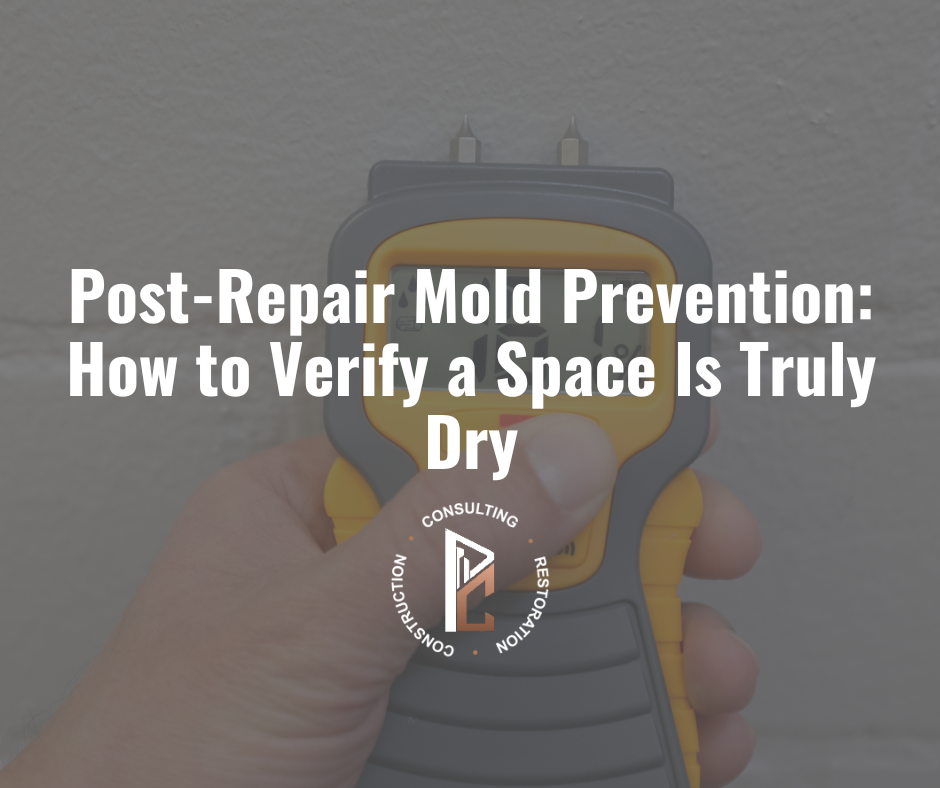
Moisture meters are indispensable tools. There are two main types:
- Pin-type meters: Measure moisture content by penetrating the material surface.
- Pinless meters: Use electromagnetic signals to scan moisture levels below the surface without damage.
To use:
- Calibrate the meter according to the manufacturer’s instructions.
- Take multiple readings across the entire repair area, including adjacent sections.
- Compare readings to baseline moisture levels for each material (wood, drywall, concrete).
Relative Humidity and Temperature Monitoring
Even if materials feel dry, high humidity can sustain condensation. Monitor environmental conditions using a digital hygrometer:
- Record relative humidity (RH)—ideal indoor RH is between 30% and 50%.
- Track temperature to prevent drops that could cause moisture to condense.
- Log readings twice daily until stable readings are achieved for at least 48 hours.
Observing Drying Progress Over Time
- Establish a drying baseline by recording moisture meter and RH readings at the start.
- Check readings every 12–24 hours to gauge progress.
- Continue monitoring until three consecutive readings show moisture levels within acceptable ranges.
If moisture readings remain elevated, review our guide on how to handle high moisture readings after repairs.
Best Practices to Maintain Dry Conditions
- Use fans and dehumidifiers to promote airflow and reduce humidity.
- Avoid sealing or covering surfaces until dryness is confirmed.
- Inspect hidden areas (behind panels or under flooring) before reinstalling finishes.
- Keep a log of all measurements and observations for future reference and accountability.
Conclusion
Verifying that a repaired space is truly dry requires systematic inspection, reliable tools, and consistent monitoring. By following these steps—visual checks, moisture meter readings, humidity control, and thorough documentation—you can confidently prevent post-repair mold and safeguard both health and property.